< last edited 22nd March – thought I was finished … wasn’t 😅 >
The Wikipedia page on crutches is a good place to start for general knowledge; it will make a difference whether you ‘just’ have one affected leg, or perhaps ‘one and a half’ or even two … assuming you have two legs at all: a friend of my youngest daughter has only one leg (since birth) … and she is AMAZING on crutches, a great example of a positive spirit overcoming a huge difficulty.
Anyway, I can only really relate my experience and hope this may help someone else get to grips with crutches a little faster / safer, PARTICULARLY if that someone is living in an apartment block upstairs without a lift – if this is you, please don’t despair (almost pulled a dad joke there and wrote ‘de-stair’ 😅 ) … I’m living on the 2nd floor of my building, my partner is on the 2nd floor of her building (no lifts in both cases), but it doesn’t stop me going to see her; I have also been doing my own laundry from the get-go of this injury despite the washing machine being in the basement … so, like, yeah, 3 flights of stairs x 3 for them to go through washing machine and dryer.
Indeed, stairs are doable … super hard and scary at the start, no question. In fact, I can only imagine what it would be like to be overweight, unfit and have little or no upper-body strength with this injury; some of what I mention may simply, at the beginning, not be doable in your case, but take heart, persevere and be careful but persistant and I’m sure you will be able to overcome initial difficulties with time! DO look for, and accept, offers of help at the beginning though … the last thing you want is to fall down the stairs adding perhaps broken bones to the list of your health problems!
One note: I got caught out fairly early on travelling by bus. I was 10mins early, the bus 10mins late … and there was nowhere to sit. I now carry a small, foldable camping stool in my rucksack for such occasions; it can also double as something to put your foot up on if you find yourself sitting down for a longer period.
Getting Started / Non-Weight Bearing
Initially, I was (automatically, without being told) walking non-weight bearing (NWB). This means bending the knee of the affected leg so that your foot doesn’t touch the floor -> you only have your unaffected foot plus the two crutches to balance on.
I’m not sure there’s too much you can do wrong here (other than not go reeeal slow at the beginning) as I think the only real option is a ‘swing-through’ – both crutches go forward, get placed on the ground in lieu of the affected foot; the unaffected leg swings through as your weight pivots from leg onto the crutches. At any rate, start, like, REALLY slow. And then still go slow, even when you think you’re getting the hang of it … I lost count of the number of times one crutch got caught somewhere (initially even the handle in the pocket of my open jacket 🤦♂️) – if you’re going slow, you can correct; if you’re trying to go fast (‘cos, let’s face it, you aren’t REALLY going to be fast, you’ll just be less slow 🤭), you will, inevitably, at some point end on your arse … or worse, on your bad foot. So, let me say it again: GO SLOWLY!
Other things to be aware of:
- Don’t forget to wipe the base of the crutches as you go in when it’s wet outside! I nearly came a cropper at least 3 times before I got that fixed in my head;
- How you grip the crutch will have a massive influence on whether your weight on the hand leads to other problems – carpal tunnel syndrome is apparently not uncommon; in my case, I ended up with pain in the ball of my hand below my little finger … it’s taken over a week to disappear in my right hand (since I transitioned to just using the left crutch); my left hand is still hurting a bit, although I’m hardly loading it now since a few days.
Grip-style
My crutches have an ‘ergonomic’ grip; it’s made of a kind of rubbery plastic so that you initially think, feels great! However, it’s a ‘one-size-fits-all’ kind of thing which inevitably means it’s made big enough for big people. Problem is, I’m not big 😅. Took me a while to twig to it, but using it in what initially is the ‘intuitive’ way means I’m putting all the weight onto the ball of my hand below the little finger (marked red below). It doesn’t take many steps for this to start hurting; it leads to a kind of (invisible) ‘bruising’ which sooner or later hurts the whole time; I did try ‘crutch gloves‘ but, to be honest, they didn’t really make a significant difference. So I adjusted the way I hold it which is just WAY better for my smaller hands; alternating the grip can further help.
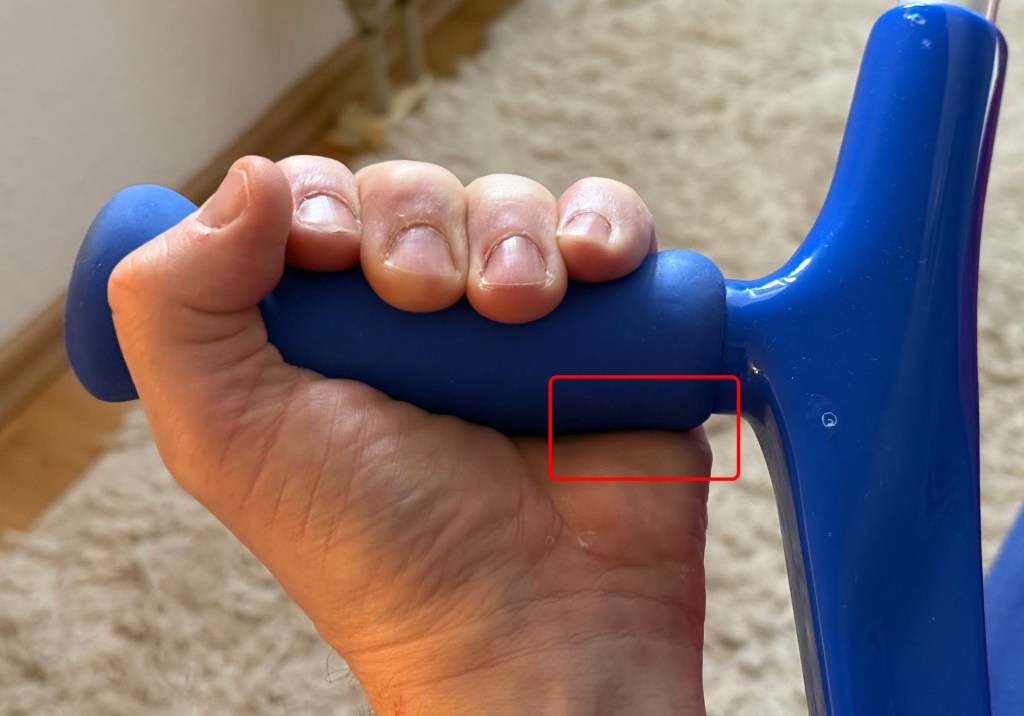
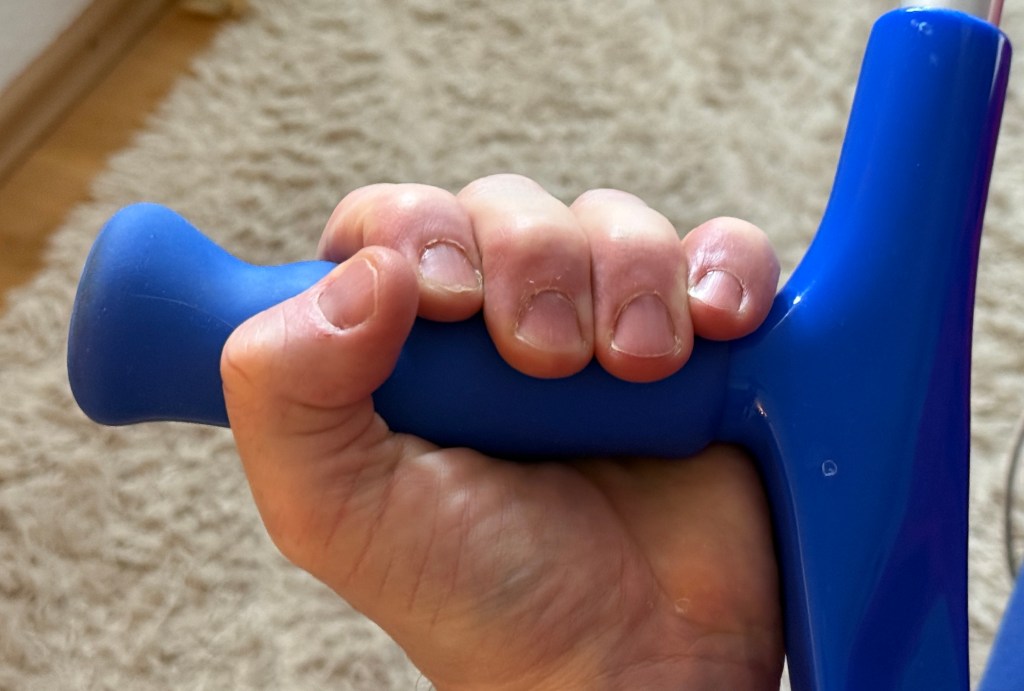
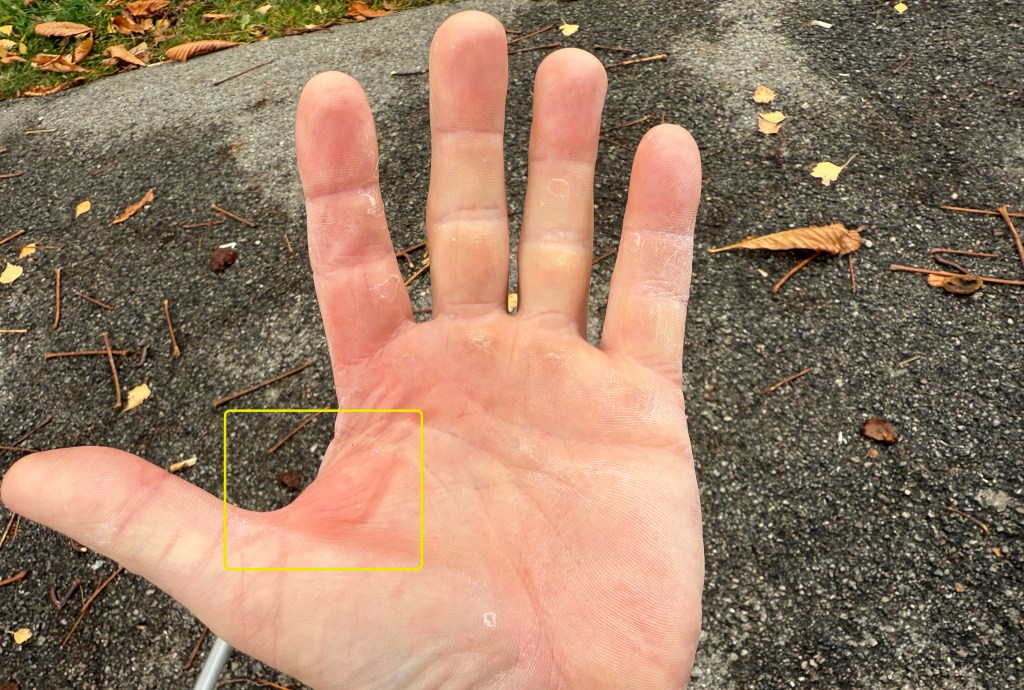
A couple of points that I didn’t consider from the start: a) as long as you’re putting significant weight onto your hands, they’re going to suffer – ‘ration’ your steps in the early days to save your hands; b) the nerves from your fingers can suffer – I’ve ended up with some really annoying (thankfully not painful) damage to the motor function of my index finger … the most important part of adjusting your grip and / or avoiding extended periods of ‘crutching around’ is to avoid any form of nerve damage. I really never thought about that until it was too late; the yellow marked area above avoids loading an area where nerves or tendons run through it.
Coping with stairs
There are a few ways to go, assuming you don’t want to ‘bum slide’ (‘scooch’) up and down the stairs – many prefere to do this, for clean indoor stairs definitely an option … tackling a train station with broken down lift, not so, so be careful before thinking you’ll never have to deal with stairs whilst you’re on crutches.
Perhaps the most obvious way is to hold onto a rail … there’s pretty much always one … but what do you do with the second crutch? Well, with mine, I can transfer the second crutch to the hand of the first one, freeing up the second hand – it can be a little tiresome when that handrail changes sides (as it does in my apartment block on the ground floor).
If you also have to cope with no handrails at all, then there is a simple (but not easy!) alternative: ‘simply’ go up using both crutches. This will probably feel REALLY ‘sketchy’ at the beginning, particularly when NWB … and certainly, you do have to be focused and careful as I already mentioned, but it’s definitely doable. I deliberately practised this at home, on the stairs next to the handrail (so I could rescue myself if necessary); in my cellar there are a few steps without handrail, so this was not ‘just for fun’. In the video I’m putting virtually no weight on the foot, it’s ‘just’ to stop it swinging around (it actually, even then, functions like the third leg of a tripod to stabilise you).
By the time I had transitioned to one crutch, I was happy to go up and down the stairs without using a handrail – this can be helpful if the stairs are wide, or don’t have a handrail at all. This will depend upon you, your fitness, sense of balance, etc. If in doubt, and you can, I would always advise you to use a handrail on the stairs.One step at a time to start with … as time went by, I just naturally started to ‘step through’, it’s closer to normal
Partial Weight-Bearing (PWB)
As time goes by, you’ll ‘graduate’ to partial weight-bearing (PWB): this is when you’ll get permission to put something like up to 10-25% of your weight onto that bad foot (in fact you’ll be instructed to do so since it is important to load the bad foot, just not too soon and also not too hard!). Scary or at least odd at first, if you’ve been NWB for any kind of a significant time … but hopefully / not necessarily painful. As soon as you’ve gotten used to it, you’ll feel much more at ease on the crutches, more stable; with time, you’ll ramp up the amount of weight you load your affected foot with.
The first question I asked myself though is: how do I know how much weight I’m putting onto that foot? You can, of course, just gradually ramp up the weight from very little … but I really wanted to know what, for example, 10kg felt like, so I turned to our weighing scales; I found filming it was the best way; initially I actually had one of my sons film it as I walked over the scales (to get the dynamic loading as the foot moves) so I could concentrate on ‘crutching’:
I really think it doesn’t harm to ‘calibrate’ yourself to get a feel for what those 10kg, or 25-75% weight-bearing, actually feels like; towards the end, you can get a feel for how much load you’re putting on a single crutch. Which brings me to the next happy development:
Ditching one of the crutches
This was a huge milestone for me, at the beginning of week 4 – it meant FINALLY being able to ‘just’ make a coffee in the kitchen myself and carry it to my desk or take a plateful of food to the dinner table. In general, I can recommend that the crutch goes on the unaffected side – I found this non-intuitive … until I compared using a single crutch on both sides; in fact, if you are any good at physics, and you think about where your centre of gravity is compared to where the points of contact on the ground are, it’s kind of a no-brainer!
Once you’re on the move outside, it also means you can hold onto things like handrails much more easily; shopping becomes much simpler as you can hold a basket. Do realise, however, that whatever weight you were putting on two crutches (and therefore two hands) now ends up pressing down on just one hand … so start with small distances, right at the start just practise at home – even there it’s handy making the stairs much safer and more manageable with less fuss!
When leaving one crutch at home, I can heartily recommend stowing a fold-up nordic walking in your rucksack … if things do get to be too much, you can use this as an impromptu second crutch.
Transitioning to Full Weight-Bearing (FWB)
From starting off at 10kg PWB after my first visit at the foot/ankle clinic (so I was only NWB for the first 3 days), I was told to use the crutches for a minimum of 4 weeks but a maximum of 6 weeks. This will, no doubt, be different for every clinic and each patient; some people have been surprised that I could ditch them ‘that fast’. For me, it has fitted perfectly: now coming to the end of week 5, I am only taking a single crutch more as a precaution when I leave home; in the flat I do without (other than the first few minutes and steps of the day, until I’m warmed up, or in the middle of the night to go pee!).
However, particularly for the longer walks (850m to the physio practice or 1700m from the station to my apartment) it really makes sense to keep a crutch with you in the beginning, just in case you end up tired. But what naturally happens as you get ready to transition to FWB is that you walk a bit quicker … and that’s when a crutch can be a little hampering, perhaps even a trip risk. My solution was to ‘feather it’ on every second step of the affected foot – this meant I wasn’t having to move the crutch fast; I also had a mini-support half the time.
Definitely a positive side effect of this method: people, including car drivers, still see instantly that you are injured and will tend to be more forgiving; without the crutch, plus the black boot cover, it will not be obvious, people will simply overlook the fact that you can’t yet walk completely normally.
De-Crutching My Life / (also) Re-Crutching My Life
I originally thought it was a fairly ‘digital’ thing: crutches until Day X, then no more crutches. I couldn’t have been more wrong. I discovered, as I adjusted the ROM on the VACOped, that crutches were really helpful for 1-3 days, particularly a) in the morning, and b) if I was going to walk a longer stretch.
Even as I was weaning off the boot, I took both crutches in my hands for those first few steps, or, again, longer walks, because you can simply take some of the weight off; more importantly, because you take some of the weight off, your gait will get out of ‘limp-mode’ much quicker, you can warm up with crutches and after a few hundred paces, just carry them in one hand, ready if you need them.
Then there was winter: with ice and snow on the ground, they were a god-send. Or walking almost 2km to the train station with a heavy rucksack – the crutches would compensate for the extra weight of the rucksack meaning it took much longer before fatigue set in.
I think so long as you are aware that they are a tool for a purpose, same as the boot, and that they are helpful for a transitional period, then – confirmed by all 3 of my PTs – you should feel free to use them whenever you need a little extra help. Better that, than to overdo it as I did at 10w 1d – THAT was a VERY unpleasant experience where two crutches would have been so much more sensible than one.
< That’s all I can think of at the moment … but as with all the other pages, info, etc., feel free to nudge me with extra inputs. >
 Achilles Rupture Recovery