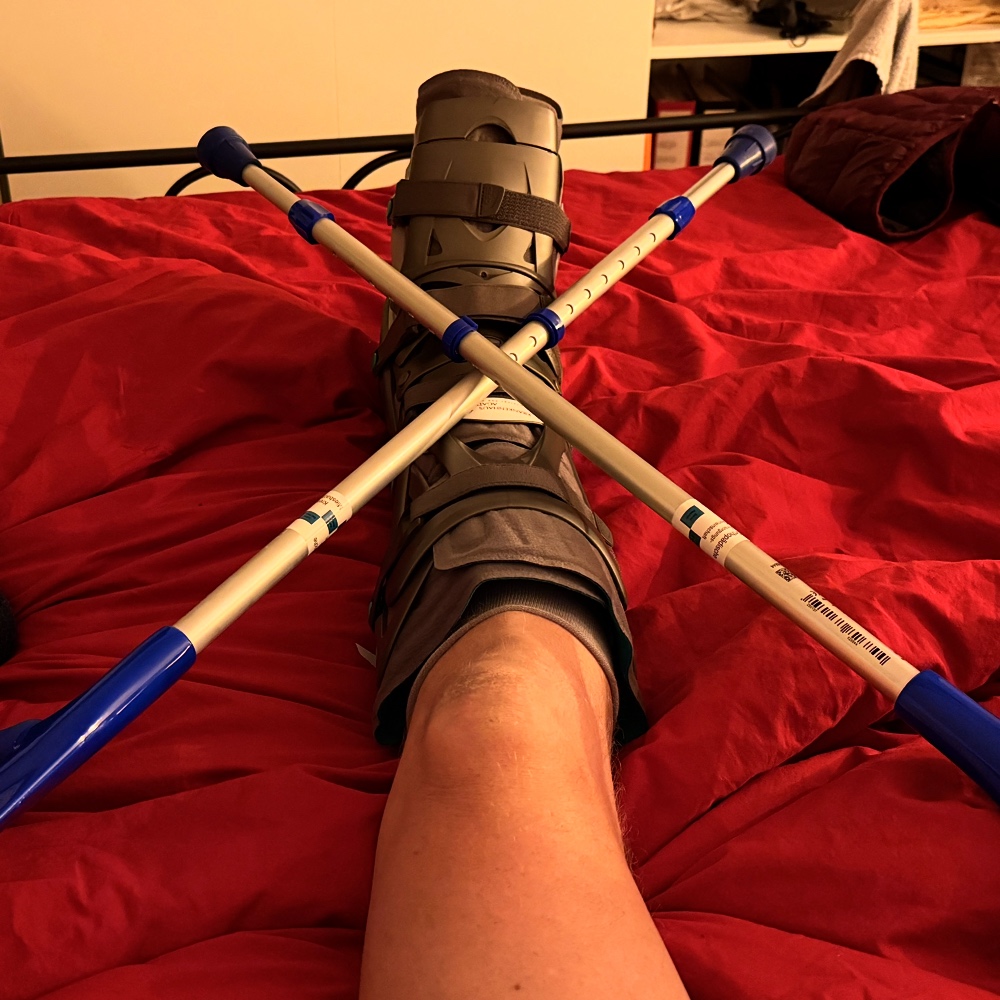
Everyday life gets turned on its head
(20th Oct 2025 – 15 mins read)
TL;DR:
– it’s a really long-term injury that starts with a ‘BAM!’
– nevertheless, there is logistic shit you need to do
– I hope my thoughts on this might be helpful for you
First things first!
Perhaps this injury “jumped out of nowhere” to cripple you, being triggered by something as banal as a hole in the ground, a stumble over a kerbstone or a slip on the stairs; perhaps you are transitioning from “Athlete/Active Person” to “Project Manager of a Recovery”, where the sport of your choice was at the centre of your injury (like me). However you happened to land on this ‘path’: the first few days can make it feel like taking care of your injury (and everything relating to it) is a full-time job; your life probably revolves around the injury and the effects on your everyday and future life.
Whether you’re a sporty person or not, it’s probably hard to accept that walking, running, cycling, driving, sports, all that normal everyday stuff will, at least for a period, be more or less taboo, regardless of how integral a part of your life these activities are (temporarily ‘were’). The inevitable questions regarding when you can start what again will abound; a plain concrete answer to any question will probably not be possible at this stage, rather it will be based upon “Well, it depends …” initially and then how your recovery progresses.
A very rough approximation I use, however: 3 months cast and/or boot; 3 months re-learning how to walk; 3 months re-learning how to run; finally, 3 months learning how to jump/skip/sprint/etc. … all those explosive activities. Some manage it quicker; some take much longer. Don’t try to rush it, stay with your protocol, consult your physiotherapist (PT) before attempting tougher steps … and remember, I’m not a doctor – I’m just journaling my own recovery and giving you some things to think about / some helpful information.
Re-focussing on the short term: there are a few things that one really needs to do as soon as possible to avoid having even more problems to deal with than the already unpleasant situation and challenge that a ruptured Achilles represents. So assuming you’re already in a cast or boot with the foot in an equinus (pointy foot) position, these things are actually more urgent than that big question of: “Do I need surgery?”. I’ll get to that later. on the next page. But don’t skip this one … please 🥹.
(If you’re not already in a cast or fitted with a boot yet: PLEASE click here!)
My personal “Day One”
I slept surprisingly well – the throbbing I experienced directly after the injury and at the hospital, which then died down once I had elevated my foot back home, stayed away; no painkillers necessary … not even close to needing them 👏 💪 !
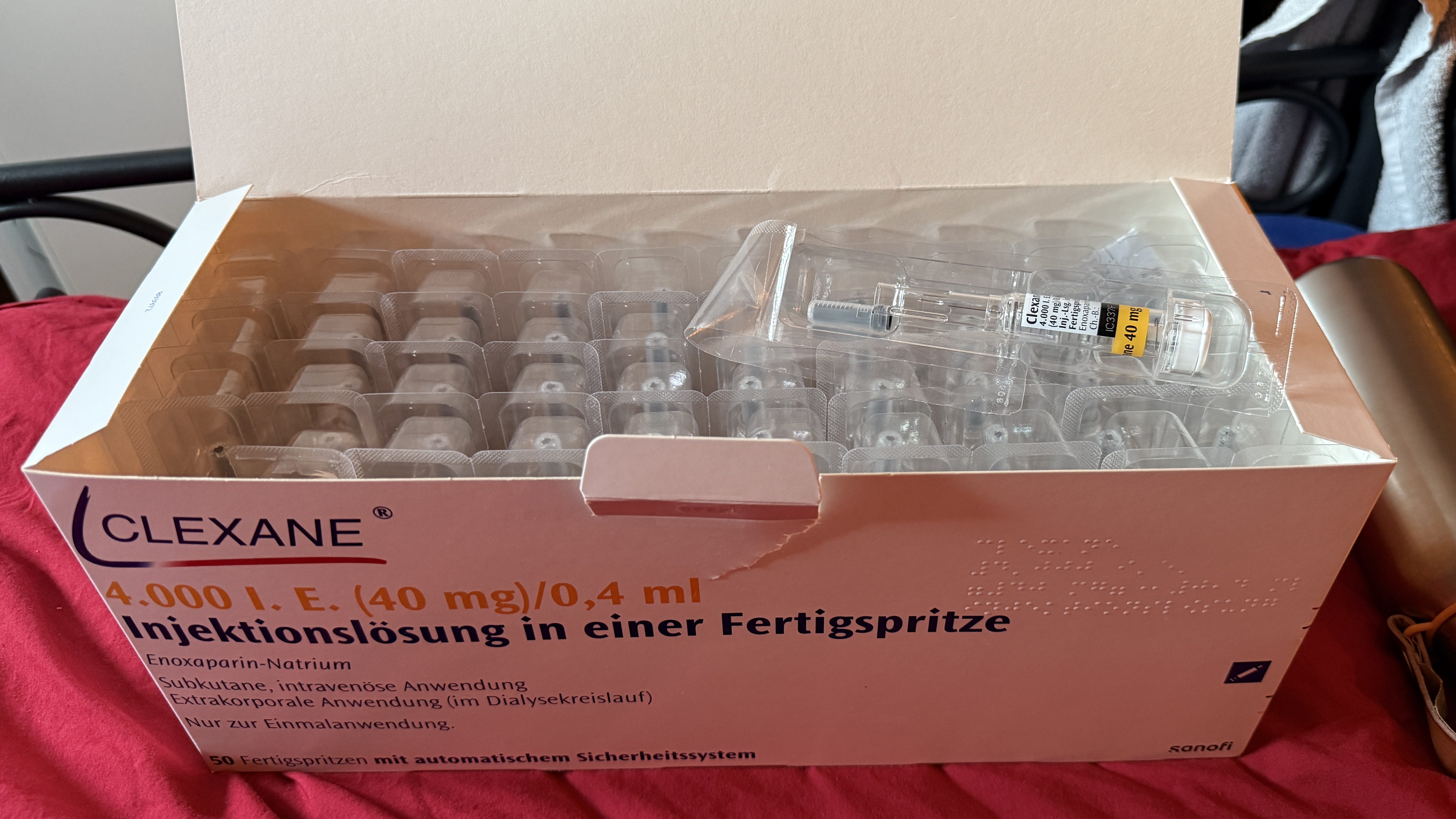
Monday started with a trip to the GP: a prescription for the blood thinner injections was top of the list … holy shit, THAT was a BIIIG package! Plus I got myself registered sick / off work for the first week, and picked up referrals for an MRI and an orthopedic doc appointment.
Next, I went down a floor in the same building to the orthopedic practice and saw a tall, dark, handsome, mid-30s doctor. Man, was he sure of himself: didn’t bother to do an ultrasound, said an MRI was a waste of time; someone ‘young and sporty’ like me (I’m 55 and no sports model 😅!) should just get myself operated as quickly as possible, REALLY the only way forward; “non-operative treatment” – what kind of negligent person was suggesting THAT was an option?!?.
Ok, maybe I’m exaggerating the tone a little, but he didn’t take more than a few minutes to look me over / ask me questions and was not willing to talk about anything other than an operation. That was a problem for me, an engineer with a scientific mindset: even though the limited googling the night before didn’t make me an expert on the subject (of course!), it did nevertheless suggest, together with the doctor’s letter from the ER, that there should at least be some kind of a discussion based on MRI pics; someone trying to ‘bulldoze’ me like this without any kind of conversation (and no good reasoning!) was a red flag.
Now, I know that many people view – subconsciously in general – doctors of all types, as much as lawyers and people of various other professions to be ‘perfect’: “But (s)he’s a doctor! Of course (s)he knows what (s)he’s talking about/doing!”. As obvious as it may seem to some, however, I learned many years ago that doctors are also just people … there are good ones, brilliant ones, mediocre ones … and those that simply have bad days or who haven’t stayed up to date on current techniques / methods … etc. etc.
Thus, already knowing that the healing was going to be very dependent upon how good the treatment was (at any rate being maaaany months until I would be through it) I spent the afternoon googling; “The Good-Looking Doctor” had at least given me one good tip: a clinic in Munich with a specialist foot department (Harlachinger Schön Klinik). It turned out that one of the ‘conservative’ (non-operative) generalists there had a slot the next morning, so I booked that.
I was less successful getting an MRI appointment: as a person with a ‘basic’ level health insurance I was looking at minimum 4 weeks before I could get one (if I had been privately insured, I could have had my choice of appointments at multiple places in the next 24 hours!). My GP was really unhappy at that when I revisited the surgery that same afternoon … she asked her assistant to telephone around and that got me onto an ‘acute list’ for cancellation replacement at a local MRI practice. Fingers crossed 🤞 🙏 !
“Day One” essential tasks
Start the DVT Protocol (Deep Vein Thrombosis): This is the most important medical task (after getting a cast or boot on your foot); it should have been highlighted both in the ER as well as at that first doctor’s visit, but in case it wasn’t: immobilisation + trauma = risk of blood clots (i.e. thromboses). So pick up your prescription (e.g., Clexane/Enoxaparin) and don’t skip that first injection (some doctors may prescribe ‘baby aspirin’ as an alternative to such single-use hypodermic syringes).
Secure your sick leave: the stress of “what about work?” can impact your physical recovery negatively. Visit your GP immediately. Even if you think you can work from home, get at least the first week signed off – you will be very grateful of this time to navigate the medical appointments that are to come as well as taking care of getting a few logistical and supply tasks / items taken care of.
This is, of course, assuming that you are not self-employed or similarly dependent upon uninterrupted work and the generated income. One such example is this Redditor using an iWalk to keep the money coming in … when I first saw this post, I thought this was an extremely “radical logistical solution” 😜 … but he’s in a very different situation from me and I think I now fully appreciate the motivation to go down this path.
Anyway, going back to the assumption that you can get time off: typical times off work will vary hugely, depending upon what kind of job you have. Whilst those with an office job, particularly with the possibility to work from home, may only be off work for 2-4 weeks (I was only off for 1 week), those doing manual labour may need more like 3+ months … this will depend very much on healing progress as well.
Whilst at your GP’s for the sick leave, also get the following, where applicable:
- A referral for an MRI (“MRT” in German) if possible; an ultrasound can be an alternative
- A referral for a Foot/Ankle Specialist if possible / orthopedic + accident if not
- A prescription for a second boot liner (if you were given a boot at the ER)
The first handful of important things to buy / organise
< I’m going to come back and do a better job on the collation of prioritised lists later, but for the moment, have a look at this ‘gear’ page I wrote early on > … it’s not great, not complete, and there are some more lists on Reddit, but perhaps better than nothing.
| Elevation Solution | Structural Integrity | Comfort/Interface | Relative Cost | Clinical Utility |
| High-Density Memory Foam Wedge | Highest | Excellent | $40 – $70 | Recommended for overnight stability and consistent edema control. |
| Inflatable PVC Wedge | Moderate | Low (plastic feel) | $15 – $25 | Useful for travel or as a low-cost, portable alternative. |
| Stacked Bed Pillows | Low | High | $0 (Owned) | Requires constant readjustment; prone to collapsing under cast weight. |
.
Some (positive!) Achilles success stories / resources to get you started
First up: don’t overdo it on the first day! Once you’ve ticked off those tasks and purchases, pretty much the most important thing you can do is put your feet up and relax, get some sleep if you can. You’re going to get plenty of time to watch series, read books, catch up with all those kind of things in the coming weeks.
Buuut … if you simply can’t sleep and/or are really keen to put some more screen time into this subject: as with most things these days, you can find any number of articles, videos, forums, etc. dedicated to Achilles ruptures. To avoid hitting you with a massive list, these principally feel-good links will probably be enough for the first day … but there will be more on the next days’ pages, so by all means, if you get that far, carry on reading!
My top three links to cast light into the dark of an Achilles rupture
The internet has endless Achilles resources – these are my top three, starting with a couple of relatively short ‘feel good’ links to take the edge off your initial trauma:
- Not a journal, but a 5min short, so maybe the place to start – over a year long recovery summed up in an inspirational video of a wild water enthusiast finding his way back to kayaking
- Return to the basketball court at about 10 months
- Not a recovery story, rather, an Achilles tendon sports rehab professional, Dr. Chris Smith, writes an excellent blog here; in addition, this is his professional Insta account
A Reddit forum and various ‘success stories’
If you’ve never used Reddit, go sign up … if only for the ‘sub’ (forum) dedicated to our injury: r/AchillesRupture; loads of helpful supportive people, advice, positive stories … but also many tales of accidents and other less positive things. For today, we’ll stick to just a few of MAAANY users with positive things to report, all relatively fresh:
- Perhaps a little early to call this a success story … but nevertherless, what this guy was achieving at just 9 months post-rupture is amazing!
- Another 9 month story of a great recovery journey
You can find me here on Reddit – it’s where I’m most active online regarding ruptures. Whilst I’d like to note that one of my first major milestones (there were maaany minor ones to read about on the following pages) was a return to climbing at 9 weeks and 2 days post-injury, shortly before Christmas 2025, I did this ONLY after my PT gave me the ‘green light’ (see various details in the comments).
YouTube recovery journeys (all with happy endings 🙏)
YouTube has endless Achilles resources, some good, some not so – here are a couple of the better personal journey stories to start with:
- SJ‘s channel, dedicated to his recovery, is probably my favourite YouTube ‘journal’. His journey started 7 years ago; he uploaded every week initially, and then did some really positive updates as he re-started with basketball at one year and then again another two years later
- One year after rupture, this lady was back on the basketball court (non-competitive)
(BTW: my YouTube channel isn’t worth linking, hence no link 😅)
Tommy Caldwell: a complicated, climber-specific recovery journey
So, this recovery journey was plagued with setbacks, some self-induced (be warned!): a professional climber, he was already accustomed to beating setbacks (cut his index finger off with a table saw and nevertheless returned to world-class climbing) when he ruptured early 2022; he was operated on, and then went on to try to return to REALLY hard climbing just weeks after his surgery … by gluing climbing shoe rubber to his orthotic boot 🙈.
Not surprisingly, that ended in tears: he re-ruptured (70%) around the 5th week. So far not so good. More worrying, however, was his 2nd re-rupture at around 6 months … at his scheduled physio appointment simply doing things his PT told him to (and this in itself is a REALLY good warning: do question what your PT tells you, when it gets to that, if you have any doubts at all … and in real doubt, refuse to do whatever it is, and get a second opinion).
Nevertheless, after then sticking to a sensible recovery protocol, he returned to world-class elite climbing between 2023 and 2025. This document I prompted Google Gemini to put together gives a good ‘shallow’ dive, looking further into this really quite remarkable recovery journey.
Instagram channels featuring ‘success stories’
Insta is abound with ‘Influencers’ … buuut I’ve also found a bunch of people with some good journaling posts:
- An amazing ‘geriatric gymnast’ (her own words 😁 !), long since back to gymnastics, starts her recovery journaling here – be warned, her rupture does literally ‘feature’ in this linked reel!
- A 40-something who ruptured mid 2023 and made a great recovery.
My Insta user is here … buuut I haven’t posted anything … really not what I’m interested in, but who knows what you might find if you rumage around my ‘following’ account list 😁.
Are you assuming you need surgery?
I assumed I would need an operation … and was completely wrong.
Those who know there is usually a decision to be made may already be fretting about whether to be operated on or not. It is, unfortunately, another: “Ask 5 doctors and you’ll get 9 different opinions” situation – every injury, every rupturee is different. You can, of course, simply ‘roll with the punches’ and do whatever the first doc says.
If you, however, want to take this decision into your own hands, as I did, then read on … because these web pages will, I believe, help you navigate the next few days, then the next few weeks, and then the months afterwards, including the next page, which addresses that big question: op or non-op?
Future-Sol’s reflections (notes from Dec 25th)
Really the most important: the “Day One” essential task – DVT protocol. PLEASE pay attention to this as well as the typical symptoms of a thrombosis … the DVT prevention protocol does not guarantee you will ‘dodge this bullet’ and recognising the symptoms early on (see link above) can be life saving!
On the “Bulldozing” Surgeon: I was pretty frustrated; his “minimal conversation” style was poor bedside manner … but above and beyond that, even if surgeons like to push for surgery early because the “window” for the best surgical results is small (usually within the first 10 days), being “bulldozed” is never okay. If a doctor won’t explain why surgery is better for your specific tear, that is a valid reason to seek a second opinion.
The MRI Struggle: I mentioned that an MRI was “definitely indicated.” While I still believe this (in order to see what kind of a gap is present, where the rupture is, whether it’s a case of ‘mop ends’, etc.), medically speaking on a basic level, a skilled doctor should be able to diagnose ‘the simple fact’ of a rupture using only a Thompson Test, perhaps aided by a MATLES test. If you can’t get an MRI for weeks, don’t wait! A good ultrasound can often give you enough information to decide on your treatment path within those critical first few days and is much easier to get than an MRI; at the very least, the plantar flexion / equinus maintenance via a boot will keep the non-op option as open as possible.
A note on inclusivity: I was, and still am, fortunate. I live in a town with multiple practices and a GP who was willing to fight for me to get an acute (short notice) MRI slot. If you live in an area with fewer resources or don’t have the same insurance “clout,” your priority on Day 1 is simply elevation and immobilization. Whether it’s a VACOped or a plaster cast, getting that foot in the “pointed” (equinus) position, if it didn’t happen yesterday, is the biological “win” for today. Everything else can wait for Day 2.
< just injured your Achilles tendon? / urgent short-term resources / resources for later on >
 Achilles Rupture Recovery
Leave a comment